

Key Takeaways
- The market for ladies designer spectacles is divided between mass-market licensed logos manufactured by conglomerates and independent eyewear brands focused on material honesty.
- High-quality optical frames utilize thermo-adjustable acetate with wire cores or hypoallergenic titanium, contrasting with unadjustable injection plastics.
- Durable hardware requires 5-barrel or 7-barrel hinges secured by physical metal rivets, rather than adhesives.
- Fitting optical lenses into third-party frames requires specific structural components, such as rim screws in metal frames.
- Sourcing platforms like Etsy carry high risks of dropshipped injection plastics, whereas visual search tools on Pinterest can identify authentic independent manufacturers.
The Structural Divide in the Eyewear Market
When consumers search for ladies designer spectacles, the results predominantly feature products from department stores like Macy’s or Nordstrom. This visibility is driven by search engine optimization dominance rather than structural design innovation. The optical industry is heavily consolidated, with conglomerates such as EssilorLuxottica manufacturing licensed eyewear for major fashion houses. These frames are designed for mass-market safety, utilizing standardized templates and shapes to accommodate the widest possible demographic.
Conversely, independent eyewear brands operate on a different manufacturing paradigm. Brands operating outside the conglomerate structure prioritize material honesty and structural integrity. Because optical frames must support prescription lenses and withstand 8 to 12 hours of daily wear, independent designers balance weight distribution with specific geometric cuts, rather than relying solely on brand logos for value.
Technical Material Specifications
The physical composition of a frame dictates its longevity and its ability to hold prescription lenses. Authentic ladies designer spectacles rely on specific base materials.
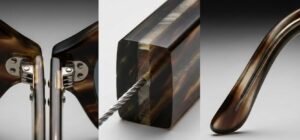
Cellulose Acetate vs. Injection Plastic
Premium frames are constructed from cellulose acetate, a plant-based polymer. Acetate possesses thermo-adjustable properties. When exposed to a professional frame heater, opticians can mold the material to match the exact contours of the wearer’s skull. High-quality acetate frames contain a visible metal wire core running through the temples to maintain structural rigidity. In contrast, mass-produced frames often utilize injection-molded plastics. These plastics lack a wire core, cannot be thermally adjusted, and are prone to snapping under the pressure of lens insertion.
Titanium and Japanese Artisanship
For metal frames, titanium is the industry standard for high-end optical wear. Pure titanium and beta-titanium alloys are characterized by a high strength-to-weight ratio, corrosion resistance, and hypoallergenic properties. The global center for titanium eyewear manufacturing is Fukui, Japan. Frames produced in this region represent the apex of Japanese artisanship, often involving over 200 distinct manufacturing steps. This localized expertise ensures the material honesty required for long-term optical use.
Anatomy of Optical Hardware and Fit
Beyond the primary chassis material, the mechanical components of a frame determine its viability for prescription lenses.
Hinges and Rivets
The junction between the frame front and the temple requires robust engineering. Independent eyewear utilizes 5-barrel or 7-barrel metal hinges. These hinges must be anchored using metal rivets that physically pierce the acetate. Lower-tier frames rely on hinges that are glued or heat-sunken into the plastic, which degrade rapidly under the mechanical stress of daily use.
Dimensional Sizing and Bridge Fit
Frame dimensions are standardized in a three-number format (e.g., 48-22-145), representing the lens width, bridge width, and temple length in millimeters. Proper alignment requires the wearer’s pupils to sit at the optical center of the lens. For individuals with lower nasal bridges, standard European fits result in the frame resting on the cheekbones. Low Bridge Fit (often termed Asian Fit) frames incorporate independent metal nose pads or extended acetate pads to maintain proper vertex distance between the eye and the lens.
Comparison: Independent Handcrafted vs. Mass-Market Licensed Frames
| Attribute | Independent Eyewear Brands | Mass-Market Licensed Brands |
|---|---|---|
| Primary Material | Cellulose Acetate, Pure/Beta Titanium | Injection Plastic, Standard Alloys |
| Hardware Assembly | 5-barrel/7-barrel hinges with physical rivets | Glued or heat-sunken hinges |
| Adjustability | Thermo-adjustable via frame heaters | Rigid; prone to melting or snapping |
| Lens Compatibility | Features rim screws for metal frames | Often sealed; high risk of breakage during COF |
| Manufacturing Origin | Often localized (e.g., Fukui, Japan; Jura, France) | High-volume global conglomerate factories |
Sourcing, Lens Compatibility, and Pricing
Visual discovery platforms like Pinterest serve as effective reference points for frame geometry, but direct purchasing through these platforms carries the risk of acquiring dropshipped replicas. Utilizing reverse image search tools allows users to trace designs back to authentic independent manufacturers. Marketplaces like Etsy should be approached with caution, as they frequently list injection-molded plastics under the guise of handmade vintage, which fail during the optical glazing process.
The Customer’s Own Frame (COF) Process
Consumers can purchase frames independently and utilize a local optician for lens insertion, a process known as Customer’s Own Frame (COF). Opticians typically require a liability waiver, as applying pressure and heat to insert lenses carries a baseline risk of frame fracture. This risk is heavily mitigated when using high-quality acetate or titanium.
Optical Lens Specifications
The performance of ladies designer spectacles relies equally on the optical lenses. Standard 1.50 index lenses are suitable for low prescriptions, while prescriptions exceeding -4.00 require high-index materials (1.67 or 1.74) to reduce edge thickness and overall weight. Furthermore, Anti-Reflective (AR) coatings are critical for maximizing light transmission and eliminating surface glare.
Assumption Note: Based on standard US retail optical pricing, single vision 1.50 index lenses range from $50 to $120. High-index 1.67 or 1.74 lenses range from $200 to $350. Opticians may also apply a COF tracing fee ranging from $20 to $50.
Frequently Asked Questions
Can I put prescription lenses into any designer frame?
No. The frame must be constructed from optical-grade materials like acetate or titanium. Metal frames must feature a rim screw to open the chassis for lens insertion. Injection plastic frames often break when opticians attempt to heat and stretch them to fit prescription lenses.
Why do opticians use a frame heater?
A frame heater applies controlled thermal energy to cellulose acetate. This softens the material, allowing the optician to adjust the temple curvature and bridge alignment to match the wearer’s specific cranial dimensions. The acetate retains this new shape upon cooling.
What is the difference between acetate and plastic frames?
Acetate is a plant-based polymer cut from solid blocks, featuring rich color depth, embedded wire cores for stability, and thermo-adjustability. Standard plastic frames are injection-molded, lack internal wire support, cannot be thermally adjusted, and become brittle over time.
How should I clean high-end optical frames?
Frames and lenses should only be cleaned using a microfiber cloth and specific optical sprays, or cold water with a drop of mild dish soap. Wiping lenses with clothing fabric introduces micro-abrasions that permanently degrade the Anti-Reflective (AR) coating and dull the finish of acetate frames.